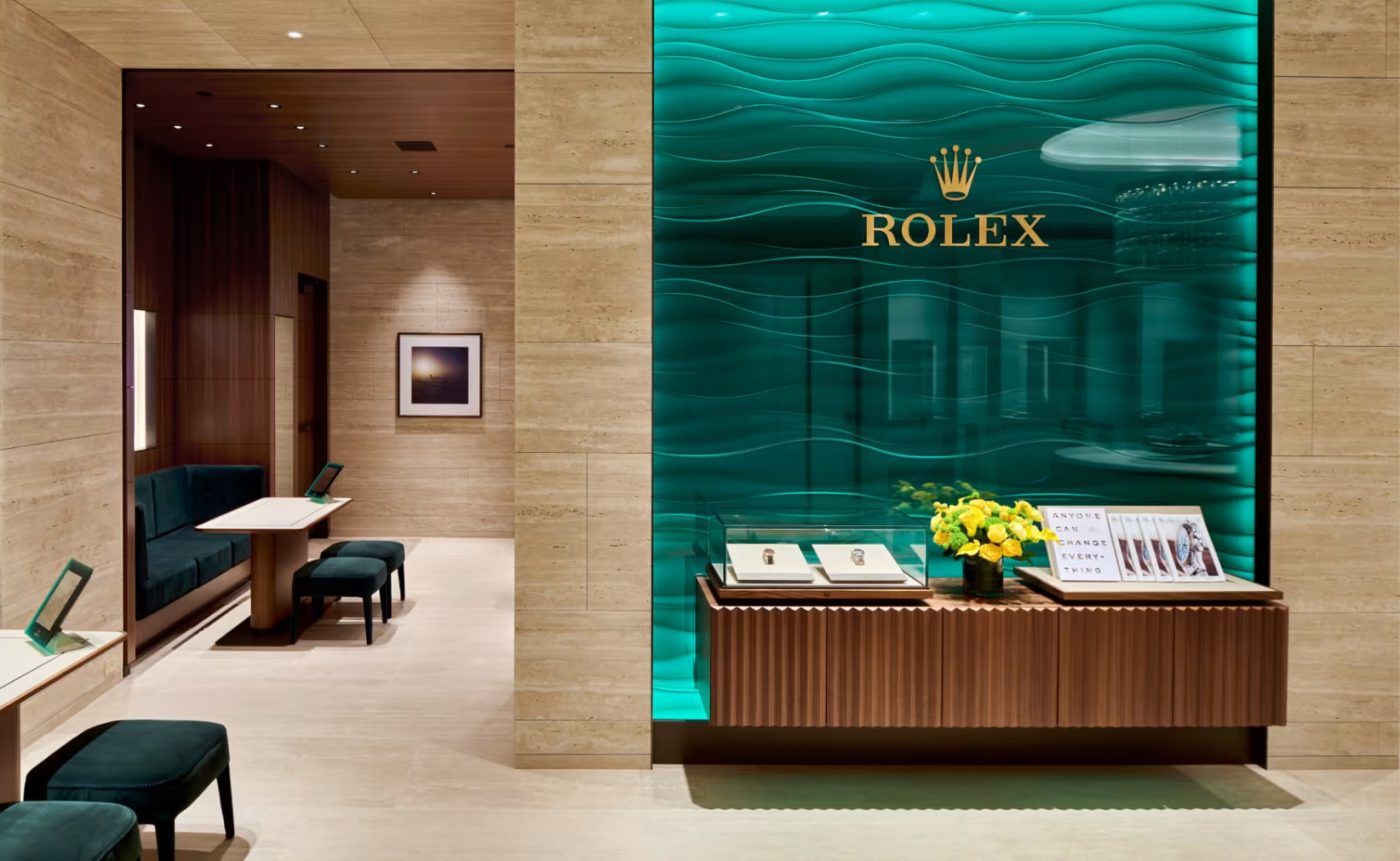
According to Morgan Stanley and LuxeConsult’s annual Swiss Watcher report, the Crown pushed its sales up 4 percent to crack CHF 11 billion (roughly $14 billion AUD) for the first time ever.
That’s a staggering number on its own, but here’s the kicker: Rolex actually put fewer watches into the market to get there. Production dropped 2 percent, marking the second consecutive year of declining output, something that hasn’t happened in over two decades.
Let that sink in. Fewer watches. More money. That’s not just brand power; that’s pricing power, and Rolex is wielding it like nobody else in the game.
RELATED: Rolex Waitlists Are Finally Cracking
Curated news for men,
delivered to your inbox.
Join the DMARGE newsletter — Be the first to receive the latest news and exclusive stories on style, travel, luxury, cars, and watches. Straight to your inbox.
One Brand, One Third Of An Entire Industry
Perhaps the most jaw-dropping stat buried in the report is this: Rolex accounted for roughly 33 percent of the entire Swiss watch industry’s sales last year, shifting around one million pieces in the process. One brand. A third of everything. That’s dominance on a level that would make most CEOs quietly weep into their quarterly earnings.
And Rolex, predictably, had nothing to say about it. The brand declined to comment on the report’s findings, which is very on-brand for a company that lets its numbers, and its waitlists, do the talking.
The Rest Of The Top Six
Rolex wasn’t the only one having a good year, mind you. Cartier slotted in at second with sales hitting around $4.5 billion, likely buoyed by the seemingly unstoppable popularity of the Tank. Audemars Piguet came third, pulling in $3.3 billion from just 53,000 watches, which, if you do the maths, works out to an average north of $62,000 per piece. Not bad for a brand whose entire identity revolves around one octagonal watch.
Patek Philippe climbed to fourth with $3.2 billion from 72,000 units, while Omega slipped to fifth at $2.8 billion. Swatch Group, Omega’s parent company, wasn’t thrilled with the report, claiming Morgan Stanley’s numbers were based on “wrong estimations, assumptions, data, figures, and statements.” A denial so thorough it almost wraps back around to being an admission.
And then there’s Richard Mille, which continues to exist in its own absurd universe. The brand sold just 5,950 watches in 2025 and still managed to generate $4.1 billion. That’s an average of nearly $689,000 per watch. If that doesn’t make you question everything about the luxury market, nothing will.
The Bigger Picture Is Even More Telling
Zoom out and the Swiss watch industry’s trajectory becomes crystal clear: fewer watches, higher prices, bigger margins. Total production in 2025 hit 14.6 million units, literally half of what the industry was churning out in 2011. Meanwhile, watches priced above $64,000 (CHF 50,000) now account for 89 percent of the industry’s growth, despite making up just 1.4 percent of all timepieces produced.
In other words, the ultra-luxury segment isn’t just propping up the Swiss watch industry. It is the Swiss watch industry. Everyone else is fighting over scraps.
With Watches and Wonders 2026 just around the corner, expect the big players to double down on exactly this strategy: fewer pieces, higher price points, and waitlists that stretch into the next decade. For Rolex, though, the real flex isn’t what’s coming next. It’s that they’ve already lapped the field without breaking a sweat.
RELATED: The Rolex Everyone Is Buying In 2025

