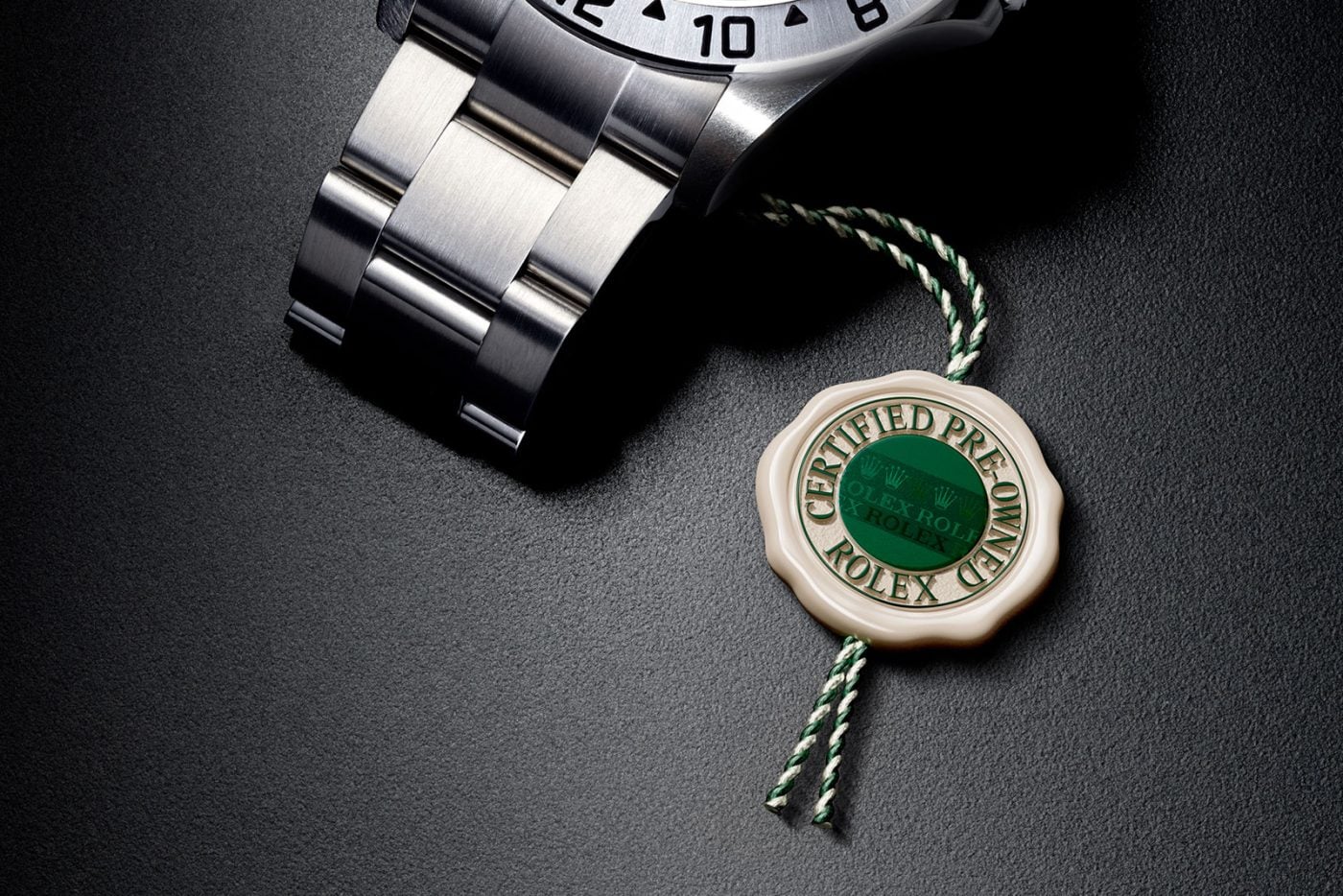
When Rolex launched its certified pre-owned program in late 2022, the industry split down the middle. One camp saw a brand finally acknowledging that resale existed. The other assumed Rolex was about to eat its own lunch, competing with grey dealers on price and cannibalising demand for new watches in the process.
Four years on, that argument is over. According to EveryWatch’s latest secondary market report, Rolex Certified Pre-Owned sales grew 101% in the first half of 2026 to USD $385 million. That is not a pilot program finding its feet. That is a business.
But the headline number is not the interesting part. This is: RCPO sales have now overtaken grey market sales of new and unworn Rolex watches, which came in at $335 million for the same period, down 25% year on year.
RELATED: Rolex’s Strategy Shift Puts The Watch Aftermarket On Notice
Curated news for men,
delivered to your inbox.
Join the DMARGE newsletter — Be the first to receive the latest news and exclusive stories on style, travel, luxury, cars, and watches. Straight to your inbox.
Twelve months ago the ratio ran the other way, and not by a little. In the first half of 2025, grey market sales of unworn Rolexes totalled $444 million, compared with $191 million through the official channel. In one year, Rolex has more than doubled its own program while the unofficial pipeline it competes with has shrunk by a quarter.
That is the whole strategy showing up in a single line of data. Rolex is not fighting the flippers on price. It is quietly drying up the supply that fed them.
The scale of the wider market puts it in context. Rolex watches accounted for $4.3 billion in secondary market sales in the first half of the year, up 43.5%, and EveryWatch projects the full year could clear $10 billion. That is closing in on what the company turns over selling new watches through the front door. The secondary market is no longer a shadow economy. It is a second business roughly the size of the first.
Where the certified demand actually sits is telling. It is not concentrated in current catalogue steel that a buyer could theoretically wait for. It is in the references Rolex no longer makes. Out-of-production GMTs, Daytonas and Submariners. Birth-year hunts. The stuff that used to require a leap of faith and a WhatsApp thread with a dealer you had never met.
The clearest example of that is what EveryWatch has taken to calling the Pepsi Effect. Since Rolex pulled the red and blue bezel GMT-Master II from the catalogue earlier this year, pre-owned sales of Pepsi references have jumped 60% year on year. The watch became more desirable the moment it became unavailable, which is the oldest trick in luxury and one Rolex barely has to try at anymore.
RELATED: The Rolex GMT-Master II ‘Pepsi’ Is Officially Dead. Long Live The King!
We flagged that in February when dealers were first told deliveries had stopped, and again in April when the product page vanished from rolex.com without a word of explanation. The 126710BLRO now exists only on the secondary market, and the numbers show exactly what that does to a reference.
None of this comes free. Certified watches carry a premium over an equivalent uncertified piece on the open market, and WatchCharts puts that spread anywhere from roughly 12.6% at some retailers to nearly 32% at others. The average certified transaction runs around $16,800 against $13,300 for any Rolex sold on the secondary market. Seasoned collectors bristle at it. They know how to authenticate a movement, they have their own watchmaker, and they are not paying an extra third for a card in a wallet.
But the certified buyer was never the seasoned collector. It is the person who was previously never going to buy second hand at all. They walk into an authorised dealer, get a serviced watch with documented restoration and an official warranty, and skip the entire education process that used to gatekeep the vintage market. Rolex has converted scepticism directly into liquidity.
The volume is concentrated where you would expect. Rolex-owned Bucherer led the certified market with $52 million in the half, with Watches of Switzerland second at $43 million and The 1916 Company third.
RELATED: Rolex 2026 Prices Revealed As Steel Watches Hit Breaking Point
Zoom out and the picture is more complicated than a victory lap. Chrono24’s new Rolex Report shows the brand accounting for 30.5% of all transactions on its platform, down from a pandemic-era peak above 44% and back to roughly where it stood before 2019. Omega is a distant second at around 11%. Patek Philippe further back again.
The more telling shift is generational. Chrono24 says buyers under 30, the group that drove the boom hardest, have cut their Rolex spending from about half their watch budget in 2022 to around a third today. That money has not left the category, it has moved sideways into Cartier, into Patek, and into dressier watches generally. The tank-shaped elephant in the room is that a 25 year old in 2026 is more likely to want something flat and gold than something 41mm and steel.
Prices across the wider secondary market now sit roughly 55% above 2019 levels and have firmed up over the past twelve months, which suggests the correction is done and the speculative froth has genuinely burned off. What is left is a market trading on taste rather than on the assumption that everything appreciates.
For Australian buyers that is a healthier place to be. Local waitlist culture has not softened much and the domestic grey market has always run with less oversight than buyers assume. A certified channel operating through authorised dealers takes a real risk off the table, even if you pay for the privilege.
The flippers made the money on the way up. Rolex made the business on the way down.

