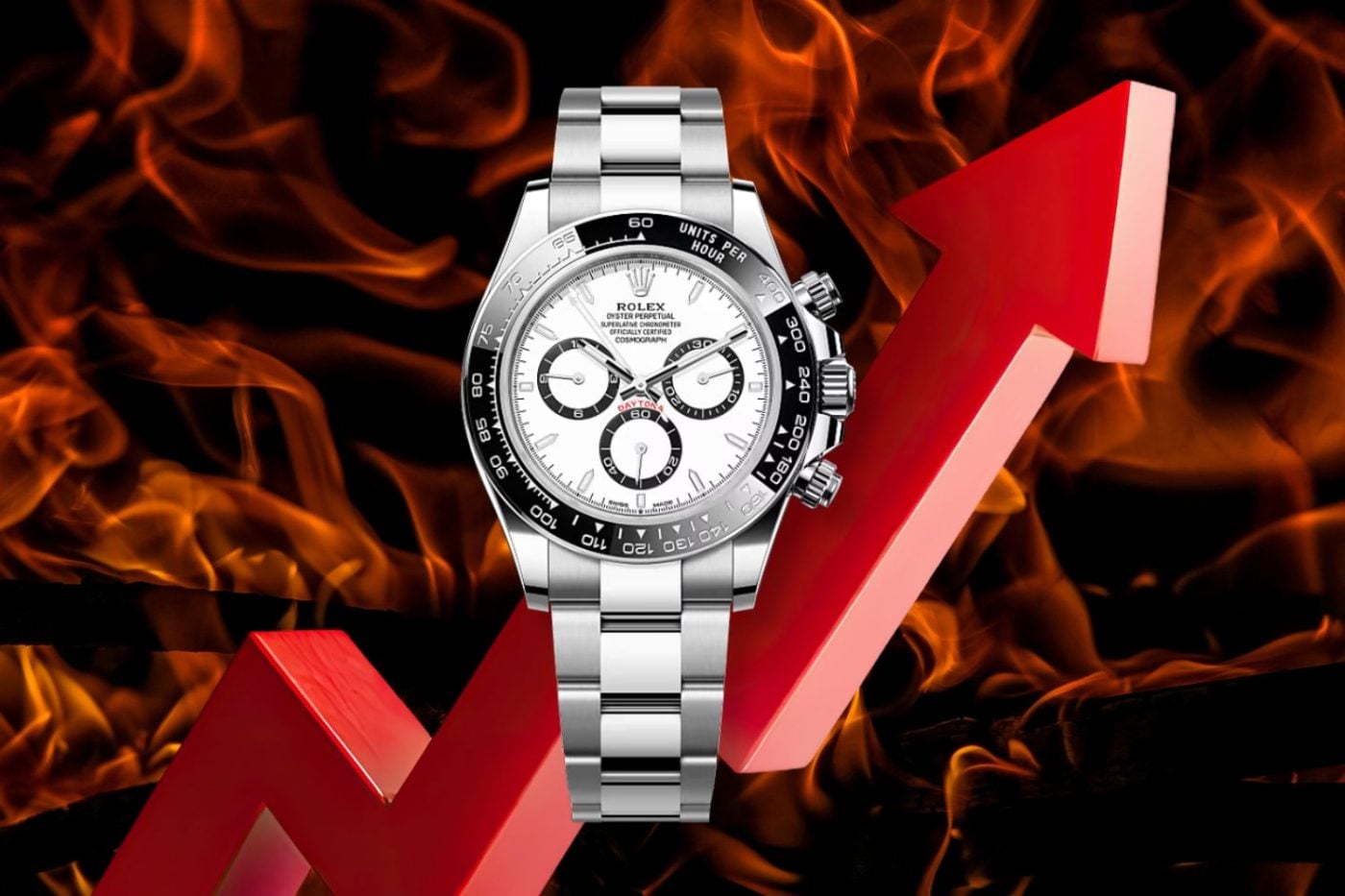
Rolex has opened 2026 by doing what it now does best: raising prices again. Quietly, decisively, and for the third time in roughly twelve months, the world’s most powerful watch brand has pushed retail higher across its catalogue.
While gold and platinum can at least lean on real-world commodity pressure, the continued escalation of stainless steel pricing now feels like something else entirely. Less strategy. More audacity.
Context matters. Rolex raised prices twice in 2025 as a defensive move against looming US tariffs on Swiss watches, briefly threatened at a punitive 39 per cent.
When those tariffs were reduced to 15 per cent in November, Rolex paused. That restraint was read as discipline. Then, on January 1, 2026, prices jumped again anyway.
Curated news for men,
delivered to your inbox.
Join the DMARGE newsletter — Be the first to receive the latest news and exclusive stories on style, travel, luxury, cars, and watches. Straight to your inbox.
In the US, average increases landed at roughly seven percent. The steel Rolex GMT-Master II on Jubilee rose from US$11,300 in December 2025 to US$12,000 in January 2026, a 6.2 percent jump. The no-date Rolex Submariner climbed from US$9,500 to US$10,050. The steel Rolex Daytona moved from US$16,000 to US$16,900.
Viewed through a US lens, the steel Rolex Submariner tells a subtler story than the outrage suggests, but it still raises flags. When the current-generation Submariner launched in 2020, the no-date model retailed for roughly US$8,100. As of January 1, 2026, that same watch now sits at US$10,050. That is an increase of about US$1,950, or roughly 24 per cent over six years, closer to 20 per cent across the last five meaningful price resets.
In isolation, that rise is not wildly out of step with the broader US economy. Cumulative US inflation from 2020 to the end of 2025 sits in the 15 to 25 percent range, driven by pandemic-era stimulus, supply chain disruption, higher energy costs, and wage pressure. On paper, Rolex can argue it has simply kept pace with the cost of living in its most important market.
Where the tension emerges is in how those increases have been delivered. Inflation rose unevenly but gradually. Rolex pricing did not.
Instead, buyers experienced long periods of stability followed by sharp jumps, including multiple increases across 2025 and into 2026. Add in the fact that stainless steel has not seen meaningful commodity inflation, and the optics shift.
Australia tells a sharper story. The steel Daytona ‘Panda’ that was AU$25,200 in 2025 now retails for AU$28,200 in 2026. The Submariner Date ‘Starbucks’ has climbed from AU$17,700 to AU$19,850. These are stainless steel sports watches, once positioned as rugged, functional icons, now drifting into pricing territory that used to guarantee precious metal or serious complications.
RELATED: Rolex Waitlists Are Finally Cracking
This is where Rolex’s argument starts to thin.
Precious metals at least offer a partial explanation. Gold prices surged throughout 2024 and 2025 amid geopolitical instability, central bank accumulation, and investor demand for hard assets. Platinum, while less predictable, has also firmed due to supply constraints and renewed industrial use. Against that backdrop, the Rolex Cosmograph Daytona Platinum moving from AU$125,300 in 2025 to AU$141,500 in 2026 is eye-watering, but not irrational. Platinum Dayonas exist in a rarefied collector space where price sensitivity is already low.
The same logic loosely applies to mixed-metal models. The Rolex GMT-Master II ‘Root Beer’ has jumped from AU$28,700 in 2025 to AU$32,800 in 2026, a AU$4,100 increase. Everose gold costs more to produce. Commodity inputs are real. The rise is aggressive, but at least explainable.
Steel prices have not surged. Manufacturing processes have not changed materially. Demand has cooled compared to the mania of 2021 and 2022. Secondary market premiums have narrowed or disappeared entirely. And yet steel Rolex pricing continues to climb as if scarcity alone is still doing the heavy lifting.
At close to AU$30,000 for a steel Daytona, the emotional equation changes. Buyers are no longer stretching. They are pausing. At that price, collectors start cross-shopping perpetual calendars, precious-metal dress watches, and high complications from rivals. Steel Rolex stops being the default choice and becomes a topic of debate for consumers.
This is no longer about demand. It is about conditioning. Rolex has trained its audience to believe prices only ever move in one direction. Waitlists, controlled supply, and resale mythology have reinforced that belief for years. The risk now is fatigue. Brand power works until it doesn’t.
RELATED: Why My Next Watch Won’t Be A Rolex
Rolex will not stumble overnight. It remains the market leader with unparalleled data and discipline. But it also sets the tone for the entire industry. When Rolex pushes steel this hard, others follow. If 2026 becomes the year luxury watch brands collectively decide that price increases are the answer to everything, the correction will not come from the market collapsing. It will come from buyers simply opting out.
Gold and platinum will always rise and fall with global forces. Steel doing the same is a brand decision. And right now, that decision feels less like confidence and more like Rolex seeing just how far it can push before consumers finally say, “No thanks,” Jeff.
If you want to compare, read our 2025 Rolex price guide article to see how much prices have changed.

