
Zahra Ciardi has spent more than a decade watching men arrive with the wrong diagnosis already in their heads.
They do not think they are anxious or burnt out. They think they have a temper problem, a sleep problem, or a business that needs one more brutal quarter before things settle down.
Ciardi is the Australian psychologist behind Ascendant Bali, a private mental health and addiction clinic run out of a three-level villa with a private chef, a pool and an ocean view. It treats one client at a time, takes 18 clients a year, and charges somewhere between US$12,000 and US$15,000 a week.
Every detail of that setup is built for a man who would never book a Tuesday afternoon therapy session. That is the interesting part of the story, and also the uncomfortable one.
Curated news for men,
delivered to your inbox.
Join the DMARGE newsletter — Be the first to receive the latest news and exclusive stories on style, travel, luxury, cars, and watches. Straight to your inbox.
Anger Is The Only Symptom Australian Men Let Themselves Have

Ciardi’s central argument is that burnout in men rarely looks like the version in the pamphlet. It does not usually show up as exhaustion or a visible breakdown.
It shows up as a shorter fuse, wrecked sleep, more arguments at home, quietly dropping off the group chat, and a sudden appetite for weekend work that everyone around him reads as ambition.
He will not use the word burnout. He will say he is flat out, or that everyone has been difficult lately, or that he just needs to get through to Christmas.
Anger is the socially permitted version of distress for a lot of Australian men because it reads as strength rather than weakness. Sadness costs status and irritability does not, so irritability is what surfaces.
The reluctance behind it is measurable. Ten to Men, the Australian Longitudinal Study on Male Health run through the Australian Institute of Family Studies, found roughly a quarter of Australian men said they would not seek help from anyone for an emotional problem, and around 80% of adult men said they would be unlikely to call a phone helpline.
Men account for about three-quarters of Australian suicides, and suicide remains the leading cause of death for men under 45. The distance between how many men are struggling and how many are asking is the whole problem, and it has not moved much.

A Villa In Bali Could Be A Workaround For Shame
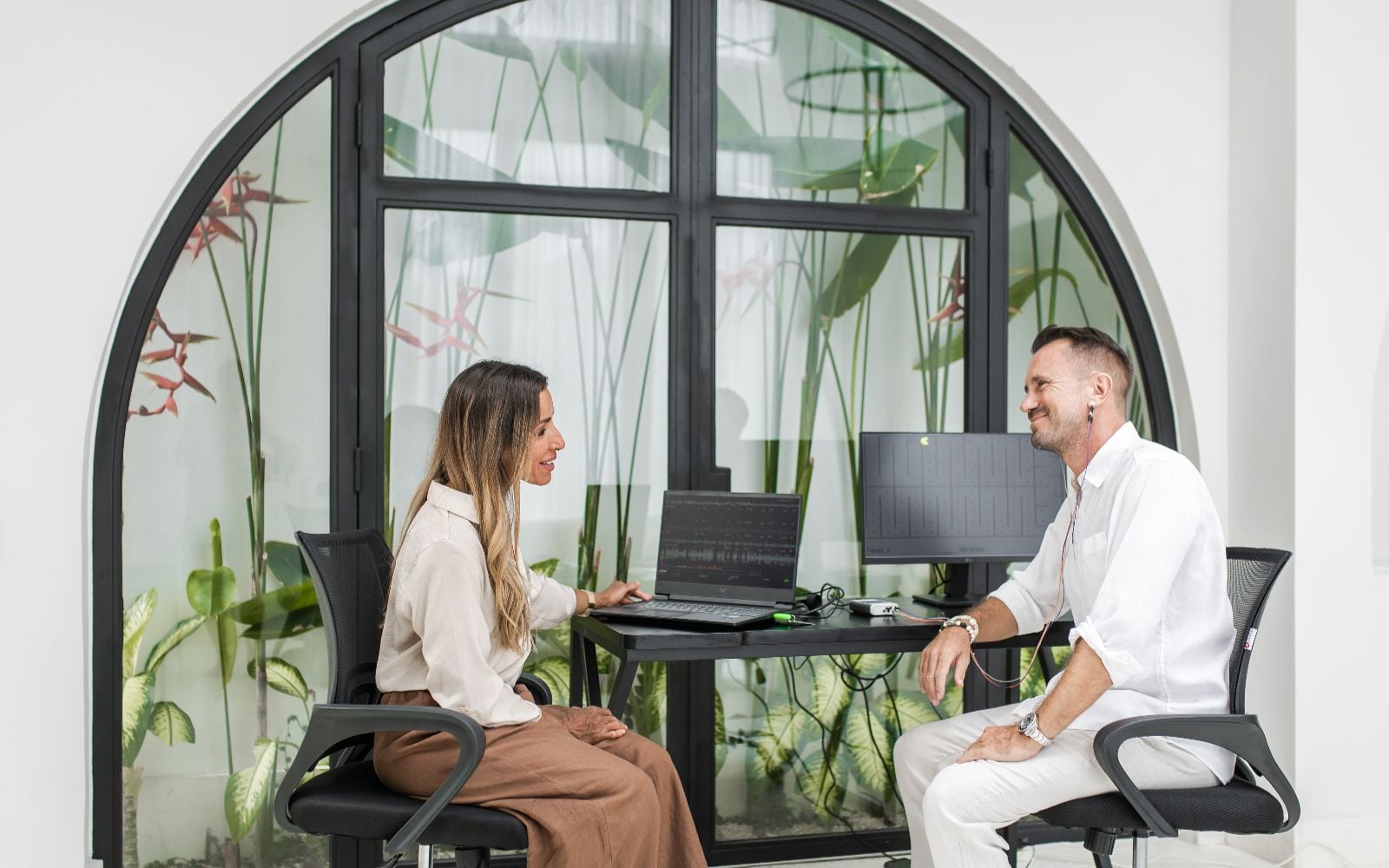
Ascendant runs what it calls a 7/21 method: seven disciplines of health across 21 to 28 days, with EMDR, CBT and neurofeedback sitting alongside somatic work, hypnotherapy, IV therapy and a nutritionist-designed menu. There is a psychiatrist, a dietician, a somatic therapist and a personal trainer attached.
The clinical case for intensive one-on-one work is real, particularly for men who freeze in group settings and will not say anything honest in front of eleven strangers in a circle of plastic chairs.
The commercial case is just as clear. Framing treatment as a private, discreet, high-performance retreat hands a certain kind of man a story he can tell his board, his mates and himself.
RELATED: I Travelled 16,632 Kilometres To Improve My Mental Health with Psilocybin Therapy
You can read that as cynical or as pragmatic, and both readings hold. A man who flies to Denpasar and does twelve hours of therapy a week is doing something, while a man who insists he is fine for another five years is not.
What it should not be is the only version that works. The treatment most Australian men actually need costs a Medicare rebate and one phone call, and it fails largely because nobody has made it feel like a legitimate thing for a grown man to do.
What To Actually Say To Him
Ciardi’s advice for partners and mates is to skip the diagnosis entirely. Telling someone he is depressed or needs help hands him something to argue with.
Naming a specific change works better. You have not slept properly in months. You snapped at the kids twice this week. You have not seen old mate Dave since March.
An observation is much harder to deflect than a label, and it leaves him somewhere to go that is not flat denial.
If any of this is sitting close to home, Lifeline is on 13 11 14 and MensLine Australia is on 1300 78 99 78, both around the clock.

