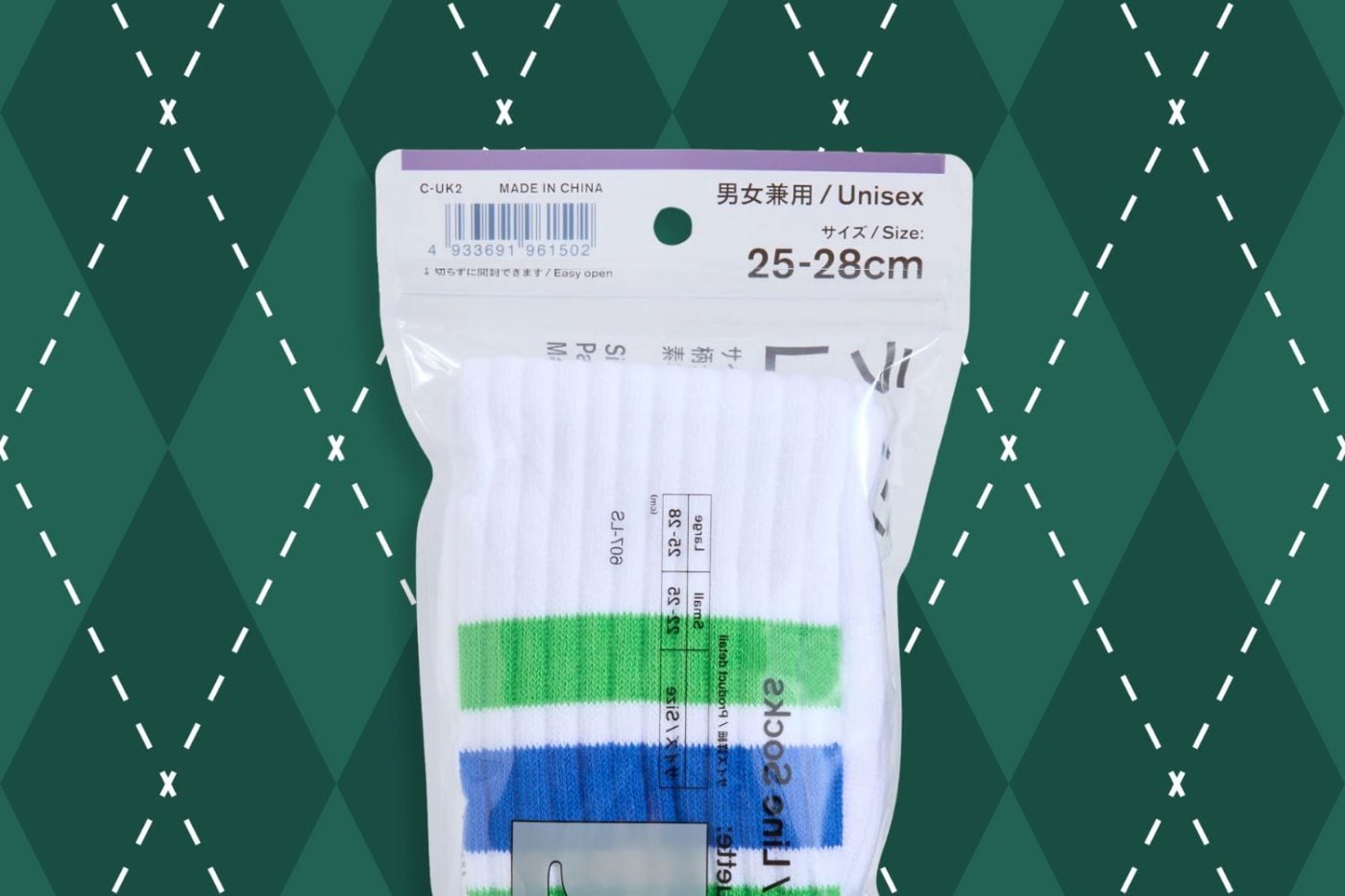
Japan has turned the humble convenience store into something bordering on a cultural institution, and right now one of its biggest exports is not sushi, streetwear, or limited-edition sneakers, but a $2 pair of striped socks you buy next to the canned coffee and fried chicken.
Welcome to the unlikely rise of FamilyMart socks, a phenomenon that neatly explains why Japan does everyday essentials better than almost anywhere else.
For most visitors, the first real taste of Japan does not happen at a temple or a Michelin-starred restaurant. It happens under fluorescent lights, surrounded by neatly stacked shelves, at a konbini. Japan’s convenience stores are not emergency pit stops. They are part of daily life, woven into routines that include breakfast on the run, late-night snacks, bill payments, and last-minute purchases that somehow never feel last-minute.
That everyday ritual has now become an attraction in its own right. Tourists in Tokyo are booking guided konbini walks, moving between stores like galleries, listening to explanations of onigiri fillings, seasonal desserts, and quiet cultural details you would normally miss if you were just grabbing a drink. One of the chains at the centre of this fascination is FamilyMart, Japan’s second-largest convenience store brand, with more than 16,000 locations across the country.
Curated news for men,
delivered to your inbox.
Join the DMARGE newsletter — Be the first to receive the latest news and exclusive stories on style, travel, luxury, cars, and watches. Straight to your inbox.
These tours are run through byFood and were born out of a simple observation. Visitors were already filming konbini hauls, taste-testing snacks, and turning everyday purchases into social media content. Someone just connected the dots and formalised it.
The obsession makes sense. Japanese convenience stores offer a level of curation that feels alien if you come from a world of sprawling supermarkets and endless brand choice. Everything has a purpose. The food is reliable, the packaging is thoughtful, and even the most basic items feel designed rather than dumped on a shelf.
That design mindset is what led FamilyMart to make a move that no other major konbini chain had attempted seriously before. In 2021, it launched its own in-house clothing line called Convenience Wear and quietly changed what people expect from a convenience store.
To lead the project, FamilyMart brought in Hiromichi Ochiai, founder of the cult Japanese label Facetasm. The brief was not to create hype fashion or novelty merch, but to rethink basics. Socks, T-shirts, underwear. Items people actually wear, made properly, priced so low they feel almost absurd.
The breakout hit was a pair of white tube socks with simple stripes in FamilyMart’s electric blue and green. No logos. No slogans. Just clean design and solid construction. They retail for 390 yen, which lands at roughly two US dollars, and they sold 1.4 million pairs in their first year alone.
The appeal is easy to understand once you hold them. The fabric has antibacterial and deodorising properties. The fit feels considered rather than generic. The packaging is reusable and oddly perfect for travel. These are not emergency socks you buy because you forgot to pack. They are socks you buy because they are genuinely better than most of what you already own.
There is also a subtle status element at play. The lack of obvious branding means only people who know will recognise them. Spotting a pair of FamilyMart socks in the wild becomes a quiet nod between travellers, designers, and Japan obsessives. It is the opposite of loud luxury and that restraint is exactly the point.
What makes the phenomenon even more Japanese is how quickly it has adopted the language of streetwear culture. New colours drop. Limited collaborations appear. Social media fills with people racing from store to store trying to secure a pair. FamilyMart has already teamed up with global pop culture properties like Stranger Things and The Simpsons, turning a convenience store essential into something people line up for.
Convenience Wear has since expanded into sweatshirts, tote bags, and tenugui cloths, each item carrying the same philosophy of good materials, good technique, and good design, applied to things you would never expect to buy with your late-night snack.
In a country where convenience stores already sell better food than many cafés and better stationery than specialist shops, the socks feel less like a gimmick and more like the inevitable next step. They are cheap, functional, quietly stylish, and rooted in daily life, which is exactly why they resonate.
Japan did not set out to make a $2 sock go viral. It just treated it seriously.

