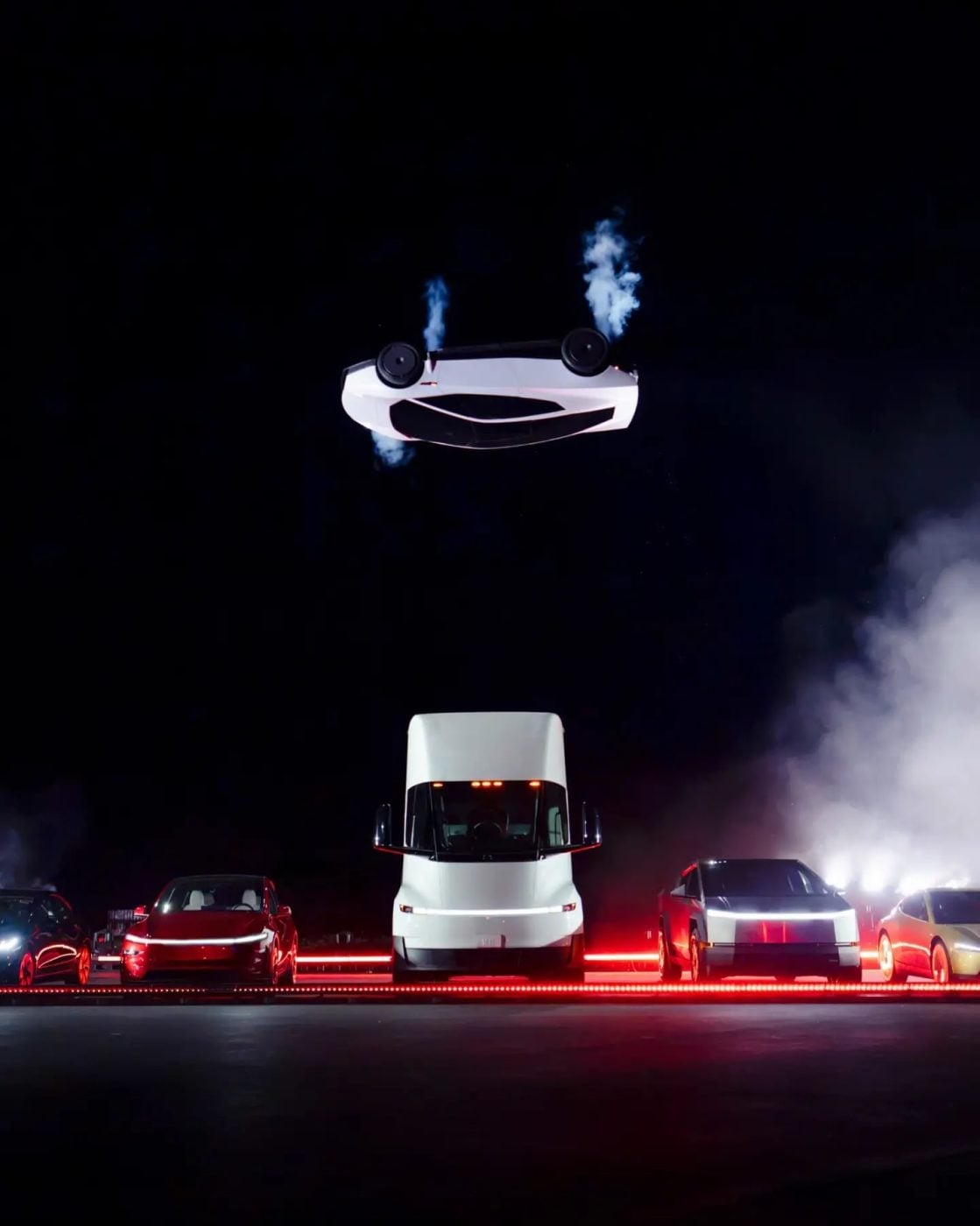
Tesla finally unveiled the new Roadster last Thursday, nine years after Elon Musk first promised it and a year after he teased tech crazier than anything in a Bond film. Naturally, the internet lost its mind over the bit where it flies, with the single-seat Rocket version launching off a curved ramp at SpaceX’s test facility in McGregor, Texas, climbing roughly six metres into the air, rotating, and landing on its wheels using cold-gas thrusters borrowed from SpaceX.
It’s a great party trick, but the more interesting piece of engineering is hiding underneath the car, and it’s a lot older than Musk would probably like to admit.
Tesla calls it the Multi-Mode Suction System. Impellers pull air out from beneath the car and seal it to the road, generating downforce even when the Roadster is sitting still. That’s how Tesla was able to drive it upside down on stage, and it’s why the company is claiming up to 2 g of cornering grip.
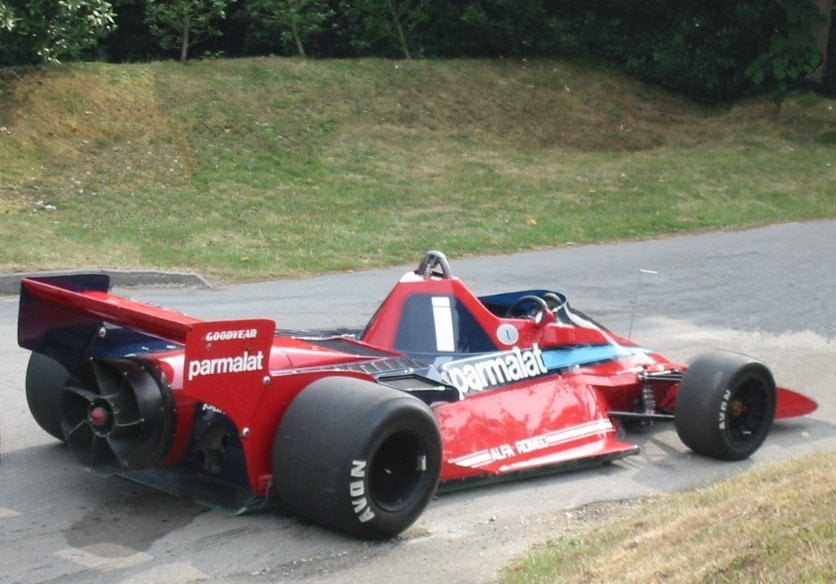
Anyone who grew up reading old copies of Motor Sport will recognise the idea immediately. It’s a fan car, and the most famous fan car of all time is the Brabham BT46B.
Curated news for men,
delivered to your inbox.
Join the DMARGE newsletter — Be the first to receive the latest news and exclusive stories on style, travel, luxury, cars, and watches. Straight to your inbox.
In 1978, Colin Chapman’s Lotus had cracked ground effect and was making everyone else look silly. Brabham’s designer Gordon Murray couldn’t copy the Lotus approach because the team’s wide Alfa Romeo flat-12 had its cylinder heads exactly where the venturi tunnels needed to go, so he did something sneakier instead.
Murray bolted a huge engine-driven fan to the back of the BT46, drawing air through a radiator laid flat on top of the engine. Officially, the fan was there for cooling, and Murray made sure more than half its airflow went through that radiator to stay on the right side of a rulebook that banned moving aerodynamic devices. In reality, it was sucking the car onto the tarmac, and everyone in the paddock knew it.
Murray wasn’t even the first to try it, either. The Chaparral 2J Can-Am racer had used fans powered by a separate engine back in 1970, but nobody had dared bring the idea to Formula 1.
The oddball detail that deserves more attention is how Brabham handled scrutineering. Because the car visibly squatted when the engine was revved, Bernie Ecclestone reportedly had mechanics Herbie Blash and Charlie Whiting stand chatting beside it with their feet tucked under the skirts to stop the fan from working. Whiting, of course, went on to become F1’s race director, which tells you everything about the sport in the seventies.
Niki Lauda drove the BT46B to victory at the Swedish Grand Prix at Anderstorp on debut, and that was that. Rivals complained it was spraying stones and grit at whoever was behind it, a claim Murray always rejected, and Ecclestone, who was busy building FOCA into a political force, withdrew the car rather than start a war with the other team owners.
The FIA had actually ruled it legal, but the regulations were rewritten for 1979 to outlaw fan cars for good. That makes the BT46B one of the few machines in history to be undefeated and banned in the same breath.
So is the new Roadster simply a BT46B with a Texas drawl? The honest answer is no, because Tesla hasn’t credited Brabham and there’s no shared hardware here, just shared physics. Wings make downforce that grows with speed, which is useless in a tight hairpin, whereas fans don’t care how fast you’re going, and that’s the advantage Murray spotted almost 50 years ago.
The bigger difference is honesty. Brabham buried its fan under a cooling excuse to slip past the rulebook, while Tesla has put suction front and centre in its marketing and is openly gunning for track records with it.
The real connective tissue between the two cars is Murray himself. He never let the idea go, and his GMA T.50 road car runs a 400mm rear fan, although it works more subtly than the Brabham’s, cleaning up airflow through the diffuser rather than acting as a brute-force vacuum. If anyone deserves a royalty cheque from Austin, it’s probably him.
As for the Roadster, Tesla is quoting 0 to 96km/h in 0.81 seconds for the thruster-equipped car and a top speed north of 370km/h. Reservations are open with a US$50,000 deposit for the Performance model and US$250,000 for the Thrust version, with production pencilled in for 2028.
Musk says it will be the only car Tesla builds that you actually drive yourself. Given the Roadster’s track record on deadlines, nobody should be taking the BT46B poster off the garage wall just yet.
