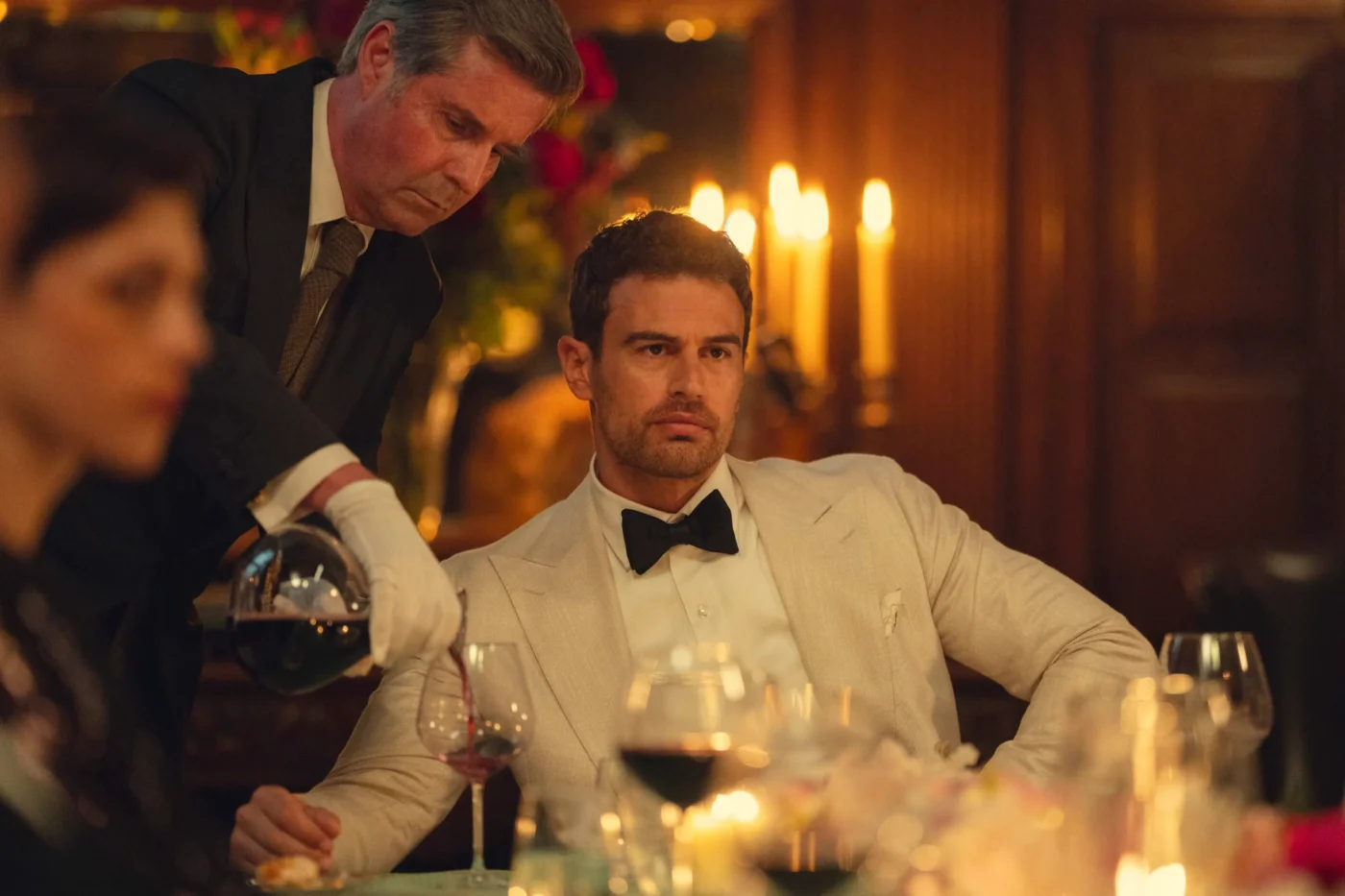
Television usually handles a watch with one move, which is a Submariner on the rich man, a gold Day-Date on the villain, and on with the scene.
The Gentlemen has reportedly more than six million pounds of watches strapped to its cast and almost none of them are used that way. Loulou Bontemps, who runs the costume department, has a rule about it that she stated twice when we spoke.
“It’s really important in costume not to do the obvious. That’s terribly boring.”
She also mentioned, without naming anyone, that actors handed a tray of watches tend to reach for the obvious one every time. She has spent two seasons quietly overruling that instinct.
Curated news for men,
delivered to your inbox.
Join the DMARGE newsletter — Be the first to receive the latest news and exclusive stories on style, travel, luxury, cars, and watches. Straight to your inbox.
Her own taste runs hard in the other direction. Speaking to Something About Rocks, she put it plainly.
“I always prefer vintage. Something antique with some history, because I like a watch that has its own story to tell. It makes me feel like I’ve found something nobody else has.”
Finding something nobody else has is the opposite of how the watch market works. The market is built on wanting the piece everyone recognises, which is why her better choices tend to take a beat to identify.
The clearest example is the one we asked her about. There are two Jaeger-LeCoultre Reversos in season two, one on Eddie Horniman and one on Susie Glass, and it is not an accident.
“I play around a lot with links between Eddie and Susie because I like to mess around with the audience a little bit. They have links here and there that are quite often symbolic.”
She is a declared Jaeger-LeCoultre fan and she likes that the Reverso plays with you, that it can be a fidget, that it works in two directions.
Of every watch available to her for an aristocrat gone crooked, though, the Reverso carries the most appropriate backstory. It exists because of a challenge issued on a polo field.
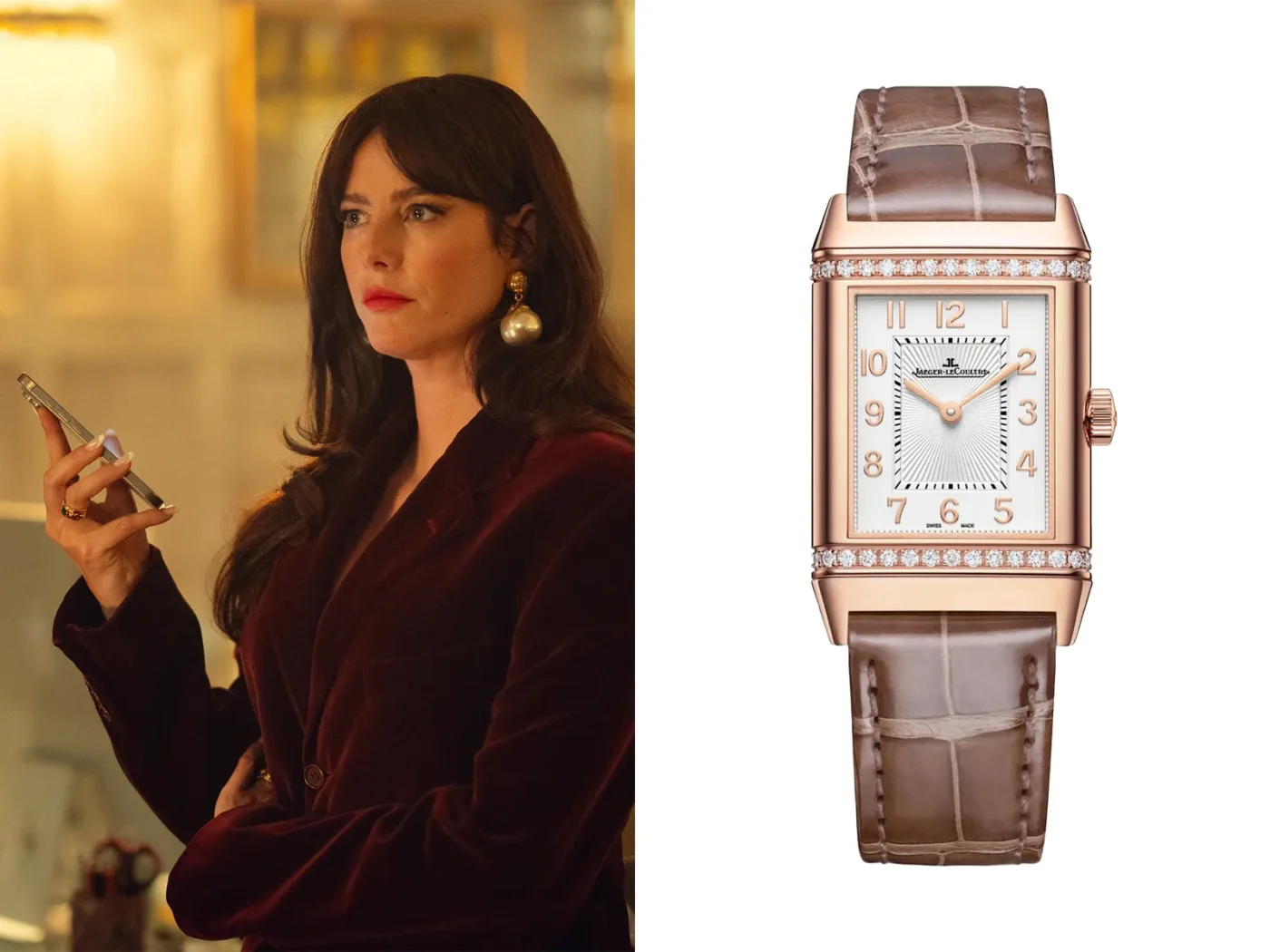
A Swiss businessman named César de Trey was travelling in India in the early 1930s when a British army officer told him no wristwatch could survive a chukka. De Trey took the brief to Jacques-David LeCoultre, engineer René-Alfred Chauvot designed a case that slides and flips onto its own back, and the patent was filed in March 1931.
So the Reverso was built for precisely the class of Englishman Eddie Horniman was born into, for the sport they play, to protect the valuable side of the object by turning it face down.
A watch designed to hide its face, worn by two people running a criminal operation behind a legitimate one. There is also the blank caseback, which owners have been engraving with private messages for ninety odd years.
The show never mentions any of it.
The obvious watches do appear, and where they do they tend to be a comment. Season one put a yellow gold Rolex Day-Date on Henry Collins, which the watch press fairly called the blindingly obvious choice for a mid-ranking gangster.
That is a man being characterised by his predictability, and it only lands because everything around it has been chosen with more care.
Eddie’s own progression works the same way in reverse. In season one he starts in a Bremont, a soldier’s watch on a soldier, and the money arrives with him rather than ahead of him.
By season two he has reportedly moved through a Daytona and an Audemars Piguet Royal Oak Perpetual Calendar, two of the most conspicuously wanted watches on earth. On him they read as evidence rather than aspiration, because we watched the man change and the wrist changed with him.
His brother Freddy wears a vintage Omega Constellation inherited from their father, worth a fraction of anything Eddie owns. One brother got the estate and the other got the watch, and nobody in the script has to say so.
Bobby Glass is the best joke in the collection. In season one he is in a Bremont chronograph with a GMT complication, a watch built for tracking a second time zone, worn by a man serving a sentence who is going nowhere.
In season two he is in a Panerai, worn in prison, because it is one of the only status objects the place will let him keep.
There is a further layer that most viewers will never clock. The production sourced real watches rather than props, then deliberately put fakes on certain characters, which means somebody sat down and decided which men in this world would be wearing the genuine article and which would be wearing a copy.
Stanley Johnston, the American billionaire trying to buy his way into British aristocracy, gets an F.P. Journe. That is the watch you choose when you want collectors to know you are serious and everybody else to have no idea what they are looking at, a fairly precise description of the man.
Her education in all this came from a film rather than from the industry. Working on The Ministry of Ungentlemanly Warfare she went down a research hole into the Dirty Dozen, the twelve manufacturers the British Ministry of Defence commissioned during the war to build to a single specification.
“There were so many different stories behind each watch, and I found a beautiful one that I put on Henry Cavill.”
The piece they found was an original Jaeger-LeCoultre from the 1940s, a neat detail given where she ended up two productions later. She had offered Cavill a spread of options, some genuine vintage and some new pieces made to look vintage, and he picked the real one unprompted.
She is not chasing hype and she is not chasing value either. She is chasing provenance.
“They each have their own little heartbeat. Especially vintage ones.”
All of which leaves an awkward thought for the next time you are saving for something. The watch everybody wants is, by definition, the watch everybody has.
