If you’ve watched any F1 coverage in the last couple of years, you’ve seen Max Verstappen wearing a Monaco. On the grid, in the paddock, during press conferences. It’s become one of the most visible watches in motorsport, and TAG Heuer’s deep involvement in Formula 1 means the Monaco gets more wrist time on camera than almost any other watch in the luxury space.
So it makes sense that the brand would give its square icon a proper overhaul rather than coast on the exposure.
TAG Heuer had a choice. It could keep polishing an icon that everyone already respected, tweaking dial colours and calling it evolution. Or it could go back to the 1969 original, the reference 1133, and actually redesign the thing from scratch. It went with option two.
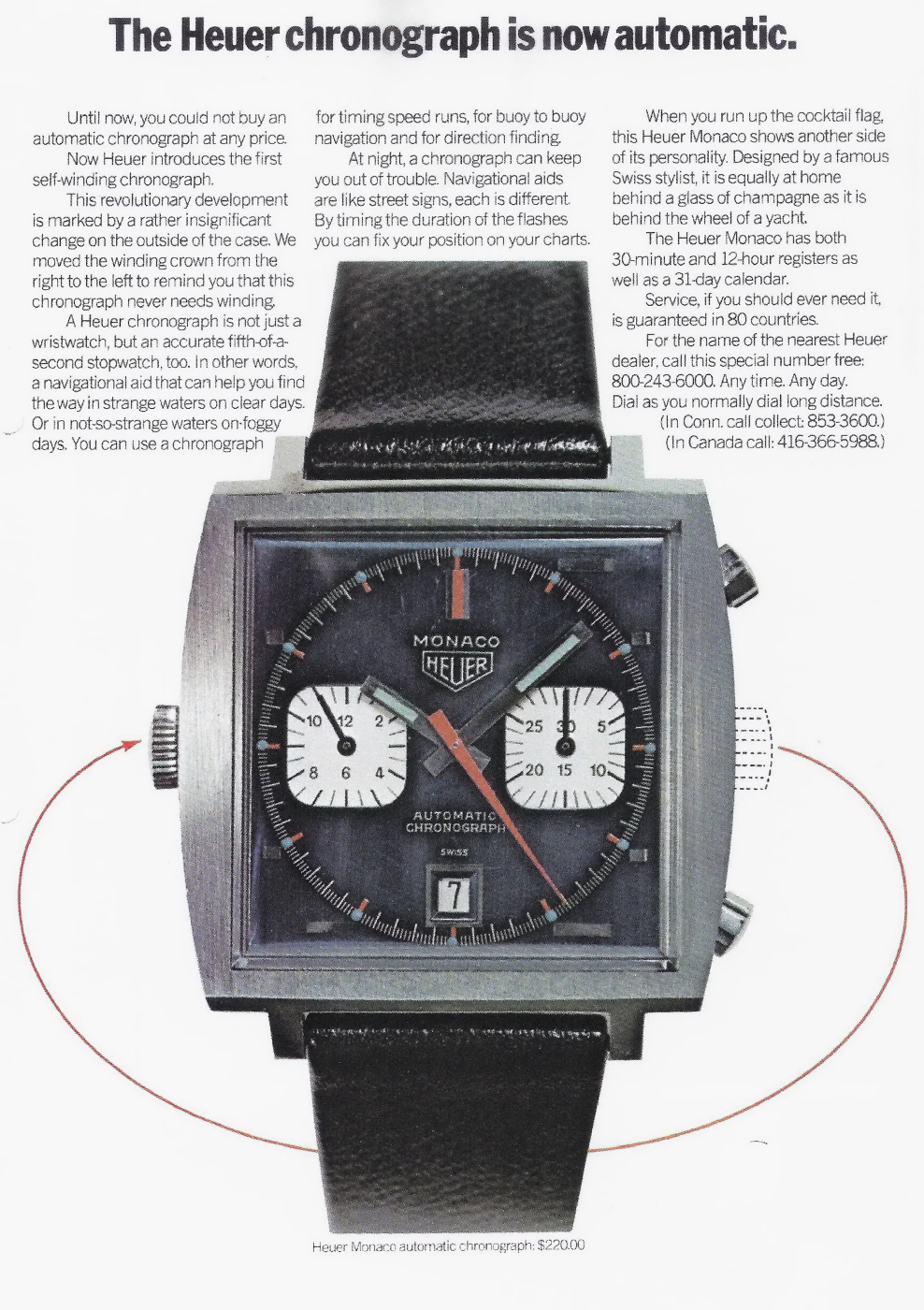
The new Monaco Chronograph is built around a 39mm grade 5 titanium case that traces its lines back to the original but fixes the one thing that’s always held the collection back: how it sits on the wrist.
RELATED: TAG Heuer’s First Formula 1 Release Is The Iconic Monaco Chronograph, Vegas Edition
Curated news for men,
delivered to your inbox.
Join the DMARGE newsletter — Be the first to receive the latest news and exclusive stories on style, travel, luxury, cars, and watches. Straight to your inbox.
The caseback uses a smaller round central section that curves toward the edges, a detail borrowed directly from the 1133 that improves comfort without flattening the Monaco’s signature angularity. The sapphire crystal is closer to a true square now, the sides curve gently, and the whole thing wears lighter and more natural than any Monaco in recent memory.
TAG Heuer has spent years getting the 1997-era Monaco design to work harder, but that watch was always, in their own words, an abstraction of the original. Sharp edges were softened, proportions were compromised, and the connection to the 1969 model was mostly limited to the square shape itself.
The redesign that started with the 2024 Split-Seconds Chronograph made the call to go back to the source, and the results are clear.
The Movement That Earns Its Name
Inside sits the new in-house Calibre TH20-11, a reconfigured version of the TH20-00 that has been the brand’s chronograph workhorse for several years. The internal teams spent several years adapting it specifically for the Monaco, shifting to a bi-compax layout with subsidiary counters at 3 and 9 o’clock and a date window at 6.
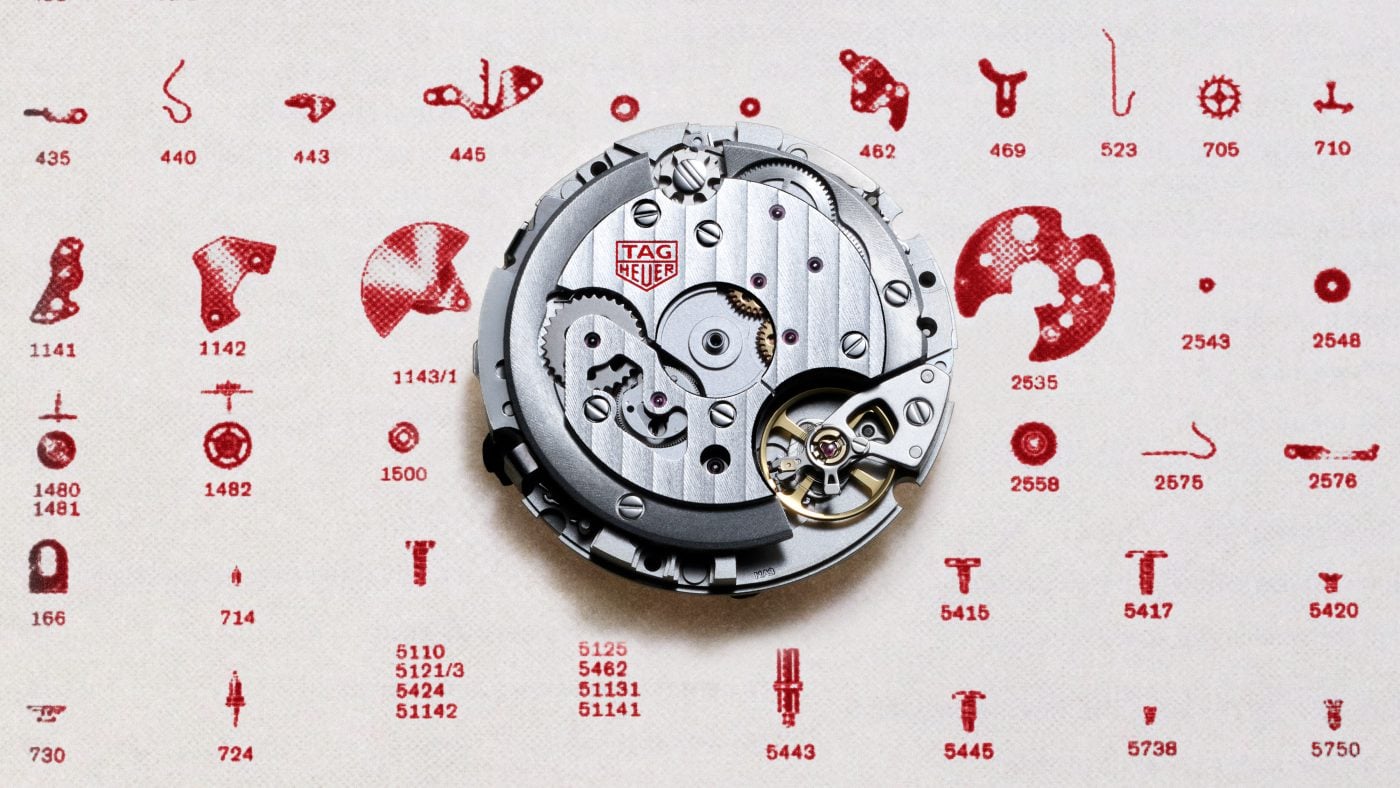
The naming is deliberate: TH20-11 is a direct nod to the original Calibre 11 that made the Monaco possible in 1969.
The crown stays on the left side of the case, as it always has, a detail that collectors will appreciate and that still functions as a visual signal that manual winding is unnecessary. Power reserve sits at 80 hours with a five-year warranty backing it up.
Three Colourways, One Clear Favourite
The collection launches in three executions. The blue opalin dial with red accents on the minute track and hands is the McQueen tribute, the one most people will want, and the one that connects most directly to the Le Mans watch.
A green sunray-brushed version plays off classic British Racing Green with rhodium-plated indexes and black opalin subdials.
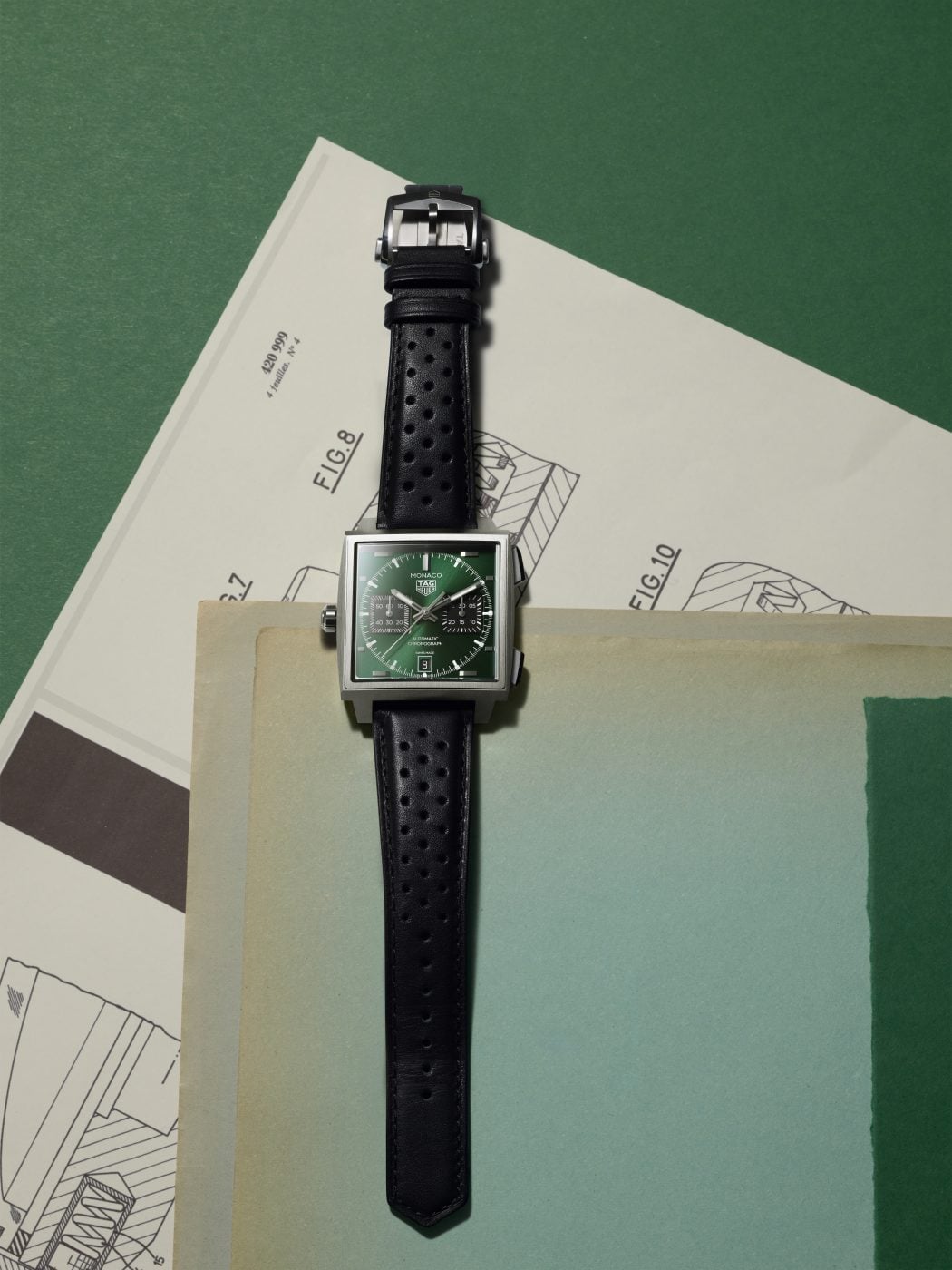
And then there’s the two-tone version: grade 5 titanium case with 18K 5N rose gold bezel, pushers, crown, and applied indexes, paired with a black opalin dial. That last one pushes the price from 8,800 CHF ($14,050 AUD) for the titanium models up to 12,300 CHF ($19,650 AUD). All three come on black perforated calfskin straps with a new titanium folding clasp.
The titanium-only references are well-priced for what you’re getting. An in-house chronograph in a newly designed titanium case at under $15,000 puts it in the same conversation as the Tudor Black Bay Chrono and Zenith Chronomaster Sport, both of which are round.
If you want something that actually stands apart on the wrist, the Monaco’s geometry does that work for you.
Specifications
TAG Heuer Monaco Chronograph
| Spec | Detail |
|---|---|
| Reference | CDW2181.FC8360 (blue), CDW2180.FC8360 (green), CDW2150.FC8360 (black/rose gold) |
| Case | 39mm, grade 5 titanium (two-tone with 18K 5N rose gold on black dial version) |
| Movement | Calibre TH20-11, automatic, in-house |
| Power reserve | 80 hours |
| Functions | Hours, minutes, chronograph (bi-compax), small seconds, date |
| Dial | Blue opalin / green sunray-brushed / black opalin |
| Crystal | Bevelled, domed sapphire |
| Water resistance | 100 metres |
| Strap | Black perforated calfskin, titanium folding clasp |
| Price | CDW2150.FC8360- $19,650 AUD CDW2180.FC8360-$14,050 AUD CDW2181.FC8360- $14,050 AUD |
Then TAG Heuer Went Further
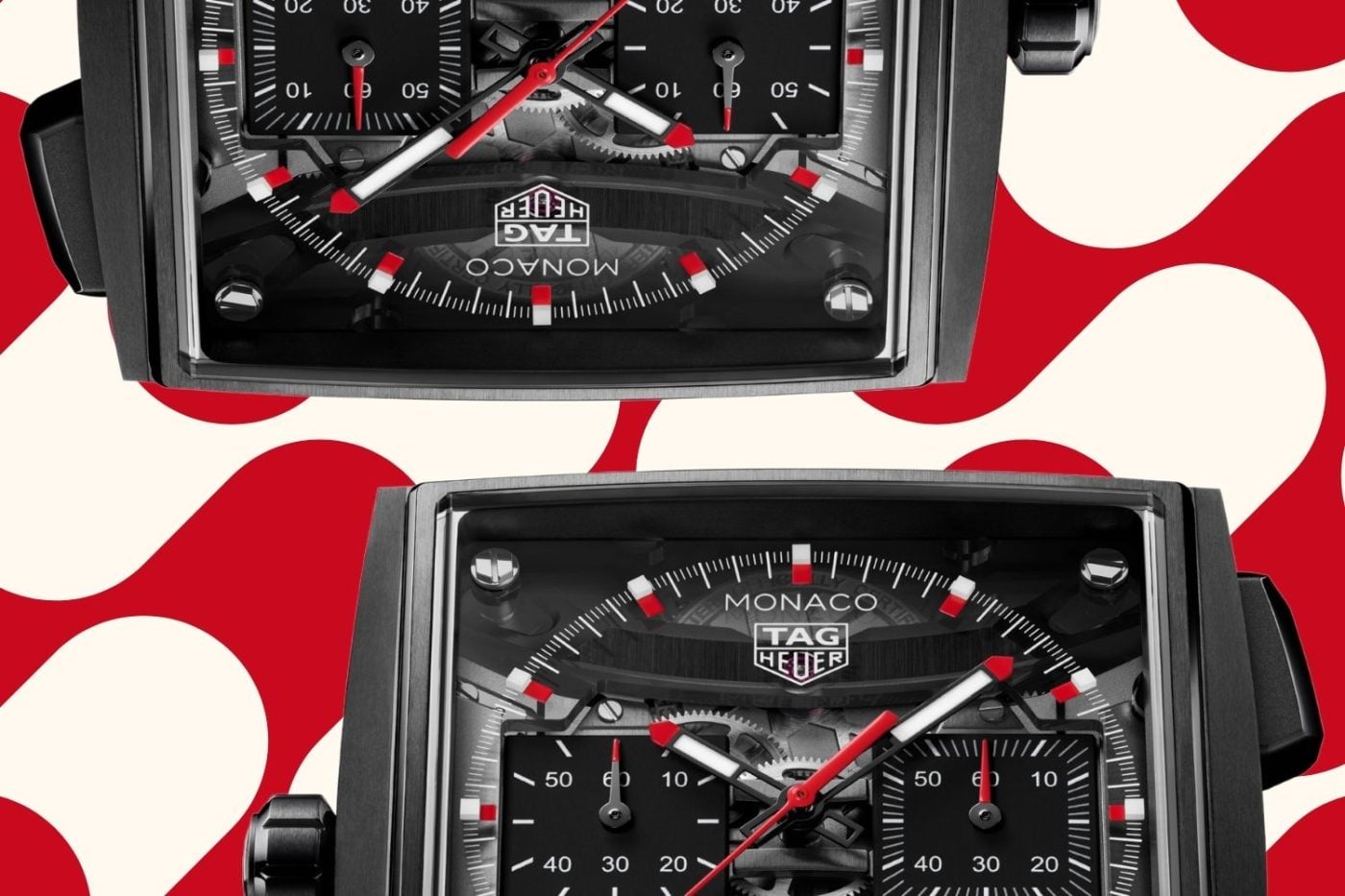
The Monaco Evergraph is a different animal entirely. Where the Chronograph is a faithful reinvention of an icon, the Evergraph is TAG Heuer’s statement piece for what the chronograph complication can become when you stop building it the way everyone has since the 19th century.
The Calibre TH80-00 at its core uses what TAG Heuer calls a “compliant chronograph mechanism,” developed entirely by the TAG Heuer LAB over five years and produced in partnership with Vaucher Manufacture Fleurier.
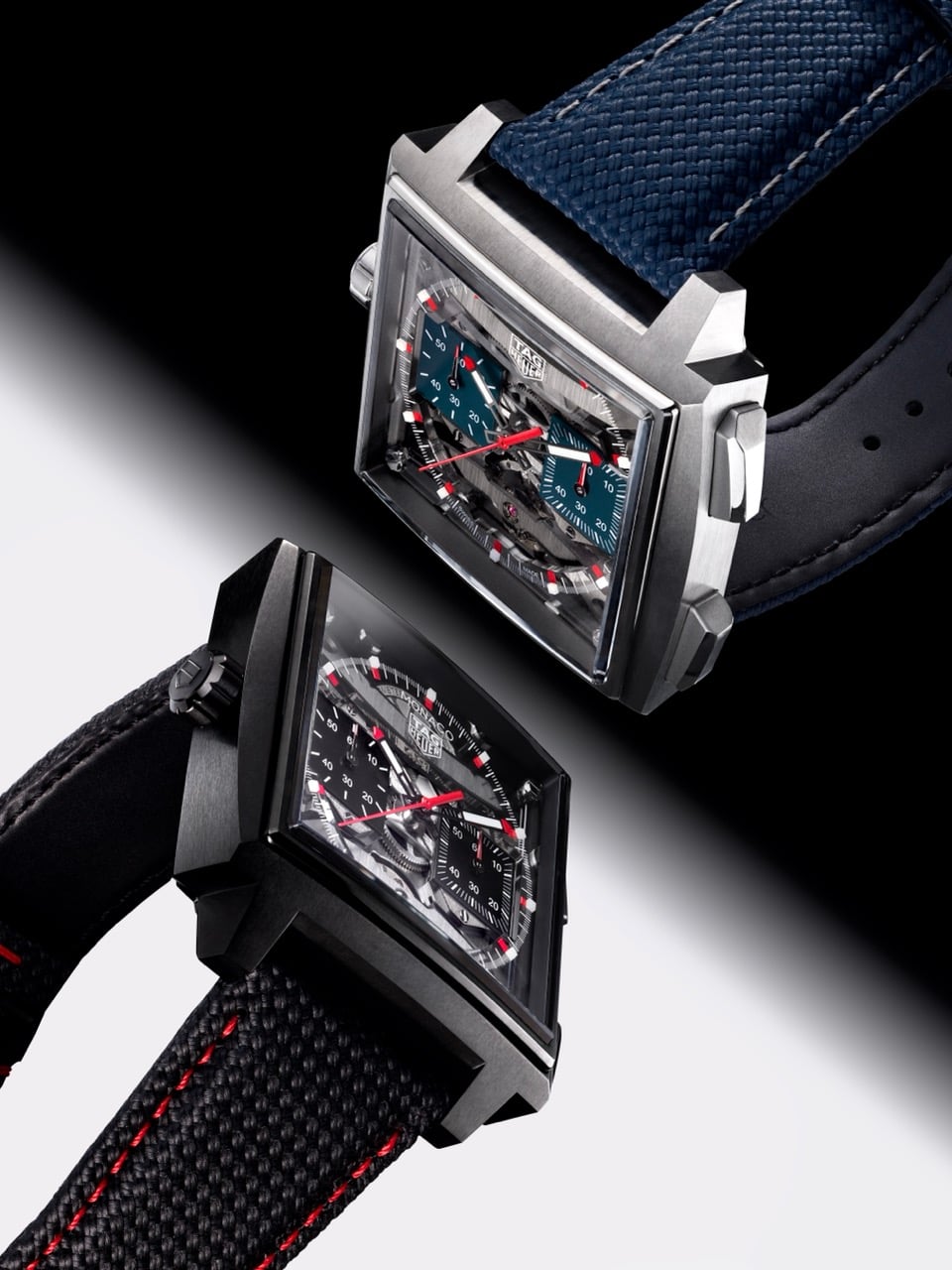
Instead of the traditional levers and springs that handle start, stop and reset functions, the TH80-00 uses two flexible bistable components manufactured using LIGA technology. One handles start/stop, the other reset.
The result is a chronograph that feels identical on the first press of the pushers and the ten-thousandth, with no wear-related deviation in performance over time.
The movement runs at 5 Hz with COSC certification, a 70-hour power reserve, and the brand’s TH-Carbonspring oscillator for magnetic resistance. The construction is inverted, placing the barrel, gear train and escapement on display through a transparent acrylic dial.
Sweeping arches hold the barrel and escapement in place while the subdials for running seconds and chronograph minutes create a deep visual symmetry. The impression is that the indications are floating inside the case.
Brutalism On The Wrist
The Evergraph case measures 40mm in grade 5 titanium with tapered profiles that create the illusion of thinness, while sharp facets along the edges give it a monolithic, architectural presence. TAG Heuer’s own description references brutalist design, and it fits.
The square sapphire caseback shows off the movement’s checkered-flag finish and shield-shaped oscillating weight. Crown on the left, elongated pushers, 100 metres of water resistance.
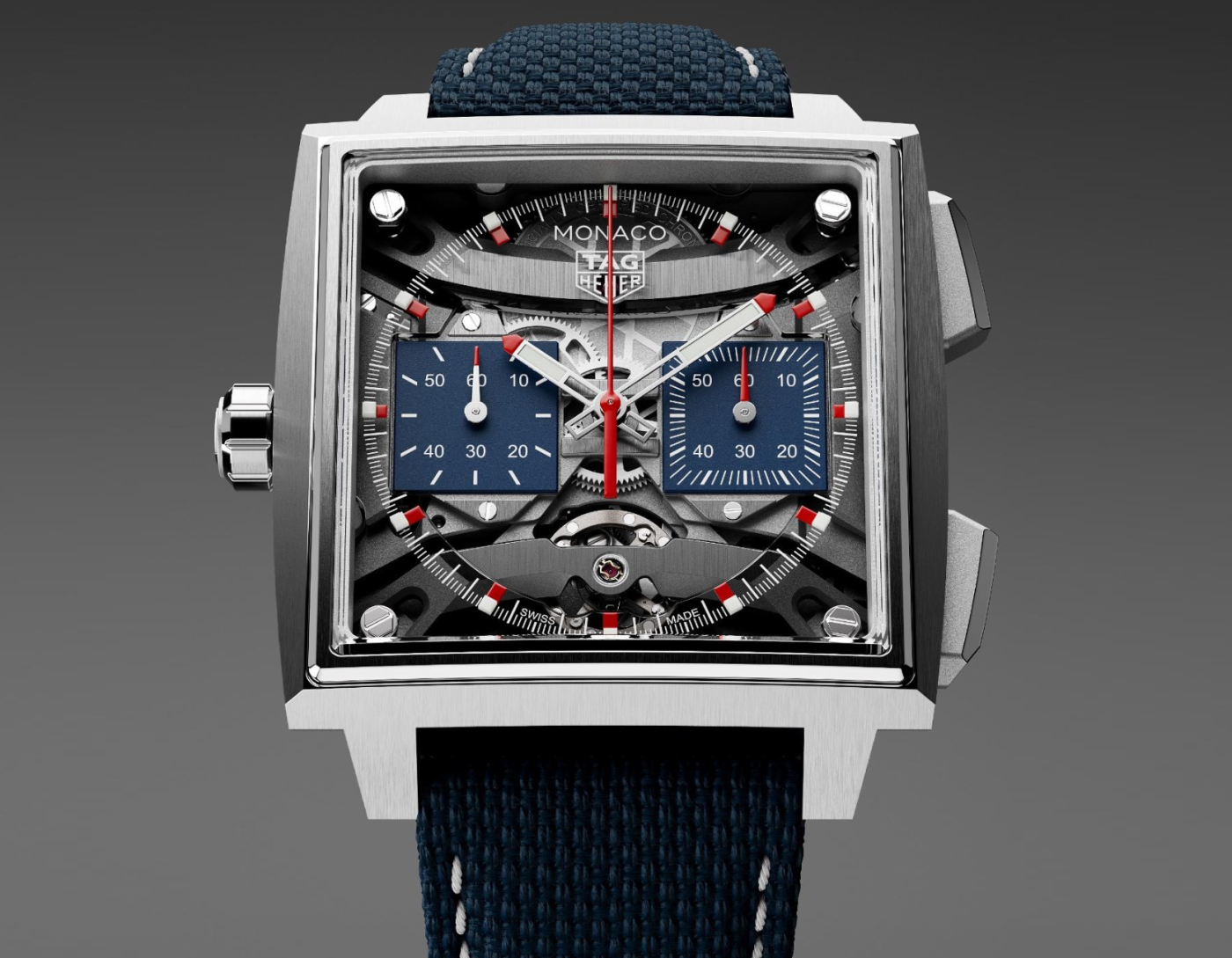
Two versions at launch: natural titanium with blue opalin subdials on a blue rubber strap with textile embossing, and black DLC-coated titanium with black opalin subdials on a black rubber strap with red stitching. Both retail at 23,000 CHF ($45,000 AUD), which puts the Evergraph in genuinely interesting territory.
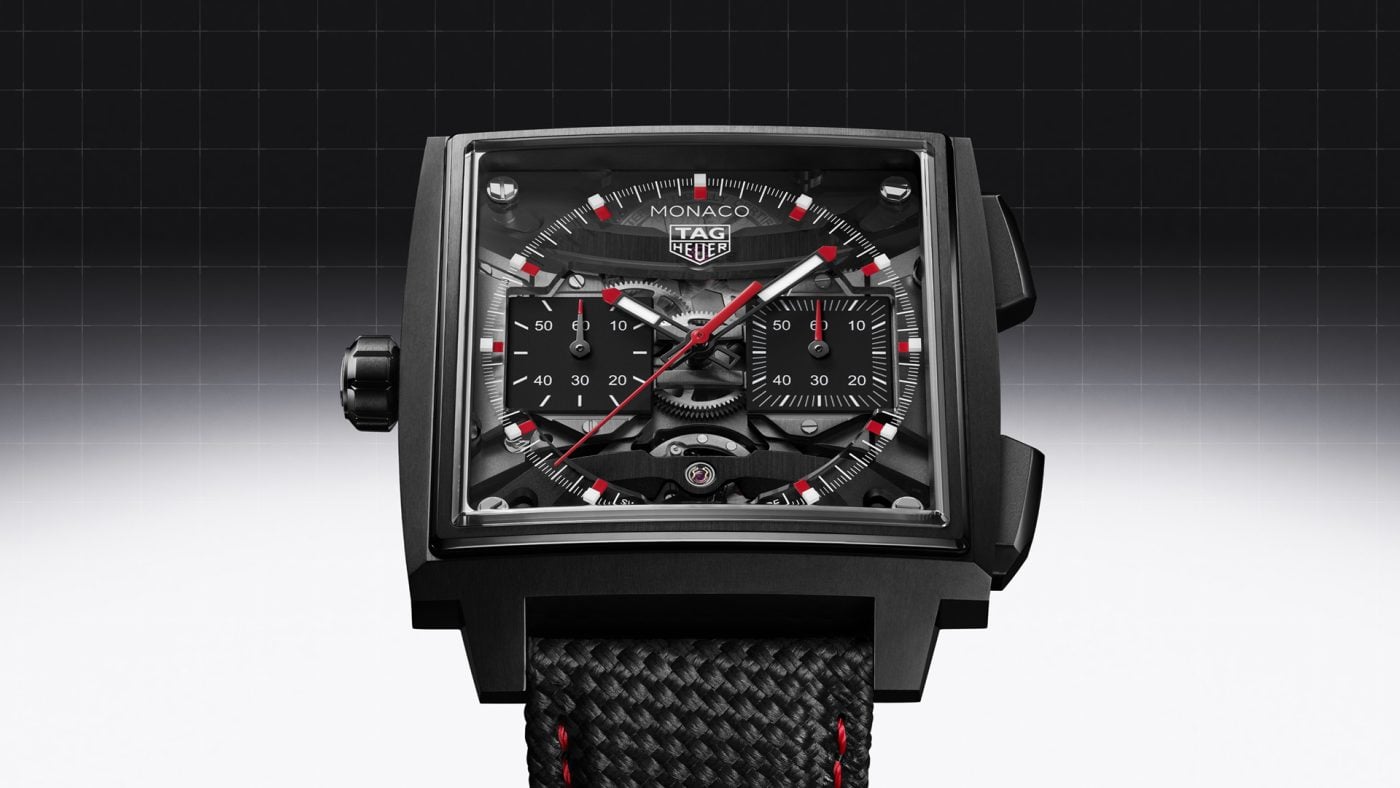
For context, the Monaco Split-Seconds Chronograph sits above this, and what you’re getting is a COSC-certified, magnetically resistant chronograph with a movement architecture that has no equivalent in the industry. Yeeeew.
Specifications
TAG Heuer Monaco Evergraph
| Spec | Detail |
|---|---|
| Reference | CEW5181.FT8123 (titanium/blue), CEW5180.FT8122 (black DLC) |
| Case | 40mm, grade 5 titanium (natural or black DLC-coated) |
| Movement | Calibre TH80-00, automatic, in-house, compliant chronograph mechanism |
| Power reserve | 70 hours |
| Frequency | 5 Hz (36,000 vph) |
| Functions | Hours, minutes, chronograph (bi-compax), small seconds |
| Certification | COSC |
| Dial | Transparent acrylic with blue opalin or black opalin subdials |
| Crystal | Bevelled, domed sapphire |
| Water resistance | 100 metres |
| Strap | Blue or black rubber with textile embossing, titanium folding clasp |
| Price | CEW5180.FT8122- $45,000 AUD CEW5181.FT8123- $45,000 AUD |
DMARGE’s Two Seconds
TAG Heuer’s 2026 Monaco play is the most coherent the brand has looked in years.
The Chronograph fixes the wearability issues that have kept people from pulling the trigger on a Monaco, gives it a proper in-house movement, and prices the titanium versions competitively.
The Evergraph, meanwhile, is TAG Heuer making a genuine case for its place in haute horlogerie on its own terms, not by mimicking Geneva’s traditional houses, but by doing what it has always done best: rethinking the chronograph.
The compliant mechanism is the real story here. If it performs as described, TAG Heuer hasn’t just redesigned its icon. It has built one of the most significant chronograph movements in recent memory.
As a TAG Heuer Monaco owner, I approve.

