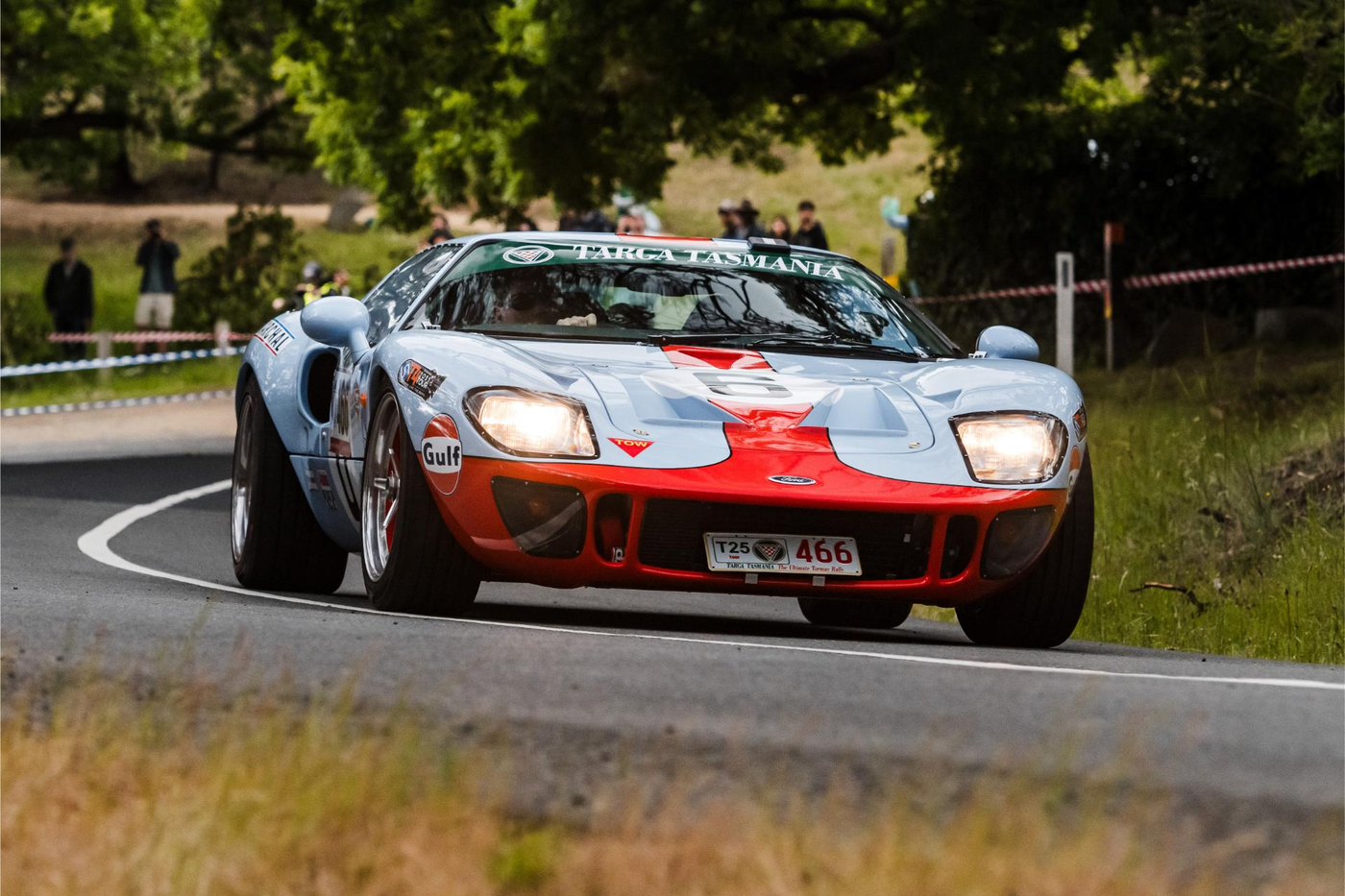
Two days out from Targa Tasmania, the strongest argument for Australia’s last great road race has come from a man who can’t legally drive for the next three months.
Earlier this month, Tasmania Police caught a 49-year-old New South Wales man doing 150km/h in a 110km/h zone at Brighton, just north of Hobart, behind the wheel of a Ferrari. He walked away with a $905.25 fine, six demerit points and a three-month disqualification.
The following day a 61-year-old Queenslander was pinged in a Porsche at 129km/h in a 100km/h zone at Hamilton. Officers seized the radar detector fitted to the car, noticed it was also missing a number plate, and sent him off with $1,810.50 in fines and three demerit points.
According to the Tasmania Police release, the operation was a response to community concerns about dangerous driving by some participants in a “high-performance vehicle tour”, along with a social media clip of reckless driving on a Tasmanian highway. Neither driver was competing in anything, and the roads they were on were open to everyone else.
Curated news for men,
delivered to your inbox.
Join the DMARGE newsletter — Be the first to receive the latest news and exclusive stories on style, travel, luxury, cars, and watches. Straight to your inbox.
Sergeant Scott McKinnell said police would “continue to target dangerous driving behaviours”, and with Targa about to roll into town he reminded visiting enthusiasts to keep it legal. Australia has form here, as anyone who remembers the Golf driver clocked at 280km/h on the Hume will tell you.
The irony is that most of the Targa field won’t be allowed to go as fast as that Ferrari did, even on roads shut specifically for them.
The 32nd Targa Tasmania runs from Wednesday 18 November to Sunday 22 November, with a ceremonial start at Launceston’s Silverdome at 8.10am and the finish at Princes Wharf 1 in Hobart. In between are 41 closed-road stages and 439km of competition, with about 150 competition crews and more than 200 cars once the non-competitive Tour is counted, reports Auto Action.
Supercup, the quickest category, is capped at 190km/h. Trophy cars top out at 140km/h, TSD Trophy and the Tour are both held to 130km/h, and every car carries a RallySafe GPS unit tracking its speed and position on course.
That puts the Brighton Ferrari above the limit for every category bar Supercup, on a public highway, with traffic coming the other way.
Calling Targa the last great Australian road race isn’t hyperbole, either, because for a while it looked like there wouldn’t be one at all. Three competitors died at the 2021 event and a fourth in 2022, after which Motorsport Australia revoked the event’s licence.
The 2023 running was cancelled and a planned April 2024 return was shelved, with Targa Australia CEO Mark Perry calling it “an unachievable task”. When Targa finally came back in November 2025, it had a smaller field, speed caps, mandatory RallySafe units and forward-facing cameras, a nine-hour Targa Academy safety course for every entrant, and new dates away from the wet autumn weather that had dogged the old April running.
This year Perry sounds a lot more relaxed. “Targa Tasmania is back, the field is strong and the course shows the island at its best,” he said.
Clerk of the Course Stuart Benson has redrawn the map as what he calls “a fresh take” on the event. There are ten new stages, including a run down the main street of Derby and a finale at Kangaroo Bay on Hobart’s Eastern Shore, while Cethana is the longest test at 37.53km and Hellyer Gorge gets tackled in both directions on consecutive days. Mount Claude and Liena, the stages that closed the 2008 event, now open this one.
We’ve had a taste of what these roads do to a good car, having taken Alfa Romeo’s Giulia Quadrifoglio to a Targa event, and nothing on the open road comes close.
The event is backed by the Tasmanian Government through Events Tasmania, with dates confirmed through 2029. If you want to drive Tasmania’s best roads quickly, there’s a right way to do it, and it starts on Wednesday.
